The third-party trading clause: what a firm can void, and when
A prop firm passing service is a contract about one clause. The trading is the visible part — the risk plan, the drawdown arithmetic, the sessions — but the clause is what decides whether the work survives contact with the payout desk. Most traders buy an evaluation, most providers sell one, and almost nobody reads the sentence that governs whether a second person was allowed to place those trades.
This is a working note on that sentence: where it hides, the three shapes it takes, what a firm can actually do with it, and what a written answer should contain before any fee changes hands.
The clause is rarely on the page you are reading
Challenge pages are marketing. They describe profit targets, drawdown, the profit split and the fee, because those are the numbers that sell. The question of who is allowed to operate the account is a terms question, and terms live behind a link at the bottom of the site — frequently in a general "Terms of Use" or "Prohibited Conduct" section rather than anywhere near the challenge description.
Two failure modes follow from that geography, and they are opposite:
- The trader assumes it is banned (reasonable, given the tone of most terms) and never asks, then either does it anyway or skips the option entirely.
- The trader assumes it is fine because a forum post from 2023 said a firm "allows account management", while the current terms say something narrower or nothing at all.
Both are the same mistake: treating a live commercial document as if it were static and as if a second-hand summary counted as a reading. Firms change these clauses, and a page you read last year is evidence of nothing about today.
Three shapes the clause takes
Across the rulebooks in the firm-by-firm rules matrix, the wording falls into three groups. The grouping matters more than any individual firm's answer, because it tells you what to ask next.
Explicitly prohibited. The terms name third-party trading, account management or "allowing any other person to access the account" as prohibited conduct. This is the clearest case and the easiest to get wrong, because the prohibition is often attached to a review step rather than to trading itself: nothing stops the trades from being placed, and the consequence arrives when a payout is requested.
Permitted on the evaluation, restricted on the funded account. A common structure, and the one that catches people who read half of it. The evaluation is treated as a test of trading ability and the firm cares less who is at the keyboard; the funded account carries different language, sometimes because the firm's own risk and KYC obligations attach to the funded stage. A provider that gets you through phase two and then hands over an account governed by a stricter clause has not solved your problem — it has moved it.
Silent. The terms do not mention it. Silence reads like permission and is not. It means the firm has not decided, which means the decision can be made later — at review, by a person, with your payout on the table. An unwritten permission is not a permission.
The only version of "allowed" that is worth paying for is the one that names the clause, the account stage and the date it was read.
What "void" actually means
Prohibited conduct clauses are usually enforced with the same remedy: the account is closed and the profit is not paid. What that looks like in sequence is worth being concrete about, because the timing is the part people underestimate.
The evaluation passes normally. The funded account is issued normally. The trader trades it, sometimes for weeks, sometimes to a first payout request. Then the review happens — and the review is where identity, access history and trading pattern are actually examined. A breach found there does not usually produce a partial payment; it produces a closed account, and the fee already paid to the firm is governed by the firm's refund policy, which for conduct breaches is normally no refund.
So the cost of getting this wrong is not the provider's fee. It is the provider's fee, plus the evaluation fee, plus every profitable day that was never paid out, plus the time. That asymmetry is the entire argument for spending twenty minutes on a terms check before spending money on anything else.
How a firm finds out
Detection is rarely forensic and rarely aimed at you specifically. It is mostly the arithmetic of a payout review:
- Login geography. An account registered in one country, funded from a card in a second and traded from IP addresses in a third is a pattern a payments team notices, because it is the same pattern fraud looks like.
- Device and session continuity. The same browser fingerprint moving between unrelated accounts, or a single device trading several clients' evaluations, is trivially visible in platform logs.
- Trade-signature correlation. Identical entries, identical sizes in fixed ratios, or two equity curves moving at a correlation near 1 — the same test firms already run for copy trading.
- KYC mismatch at withdrawal. The account holder must verify personally. A payout request is the moment the name on the account, the name on the bank and the person who has been trading all get compared at once.
None of this requires the firm to be looking for you. It requires the firm to look, once, at the point where money leaves. Which is exactly the point where an unwritten permission stops being comfortable.
What a written terms check has to contain
"We checked, it's fine" is not a terms check. A usable answer is short and has five parts, and you can ask any provider for it before paying:
- The clause, quoted. Not paraphrased, not summarised — the sentence that governs third-party access, copied from the current document.
- Which stage it covers. Evaluation, funded, or both. Two separate answers where the firm separates them.
- The date it was read. Terms change. A date turns the claim into something you can re-check.
- The scope of access. Which account, which permissions, what happens to the credentials at handover, and confirmation that access ends when the evaluation does.
- Who carries the enforcement risk. It is the account holder. A provider that implies otherwise — "we guarantee the payout", "the firm can't tell" — is describing a risk transfer that does not exist.
That last item is the one to be blunt about, including with yourself. A passing service can reduce the chance of a rule breach, because it has read the rulebook. It cannot absorb a conduct decision made by a firm that is not a party to your arrangement with it. The propfirm passing service exists for exactly this reason, and it is the one stage of the process that can end with "no".
Four questions to ask before paying
These are worth sending verbatim, in writing, and keeping the reply. A provider who answers them in one message has done the work. A provider who answers with enthusiasm instead has told you something too.
- "Quote the clause in my firm's current terms that covers someone else trading my evaluation, and tell me what it says about the funded account."
- "What happens if the firm voids the account at payout review on that clause — who bears it, and what does your retry policy say about a failure of that kind?"
- "What access do you need, for which account, and when is it removed? Will the password be changed at handover?"
- "Which firms have you declined, and why?" — a provider with no refusals is not reading the terms.
What this changes about the fee
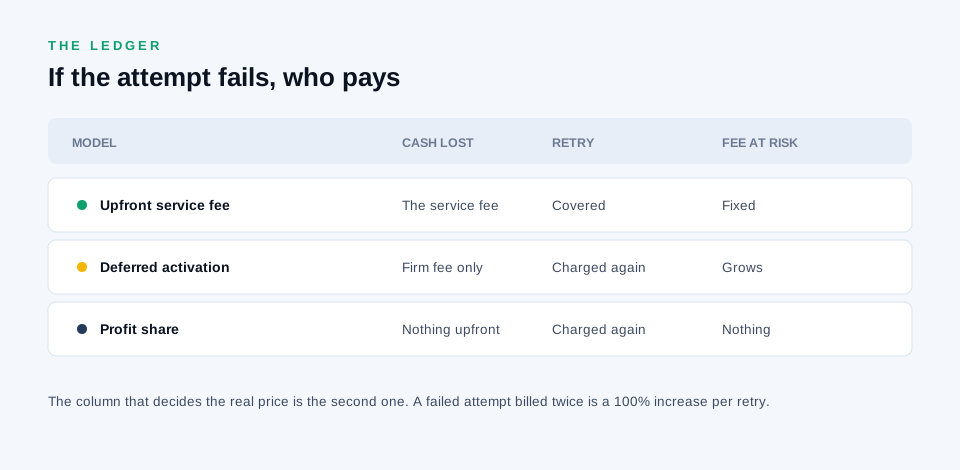
It reframes what you are buying. A flat fee for a passing service is buying rule compliance and execution, and the terms check is the part of that purchase with the highest value per minute: it costs nothing, and it is the only part that can prevent a total loss.
The fee arithmetic is otherwise ordinary. You pay the firm's evaluation fee yourself, in your own name, because the account has to be yours — that is not a technicality, it is the thing that makes the funded account payable to you at all. In the flat-fee model the provider takes no share of your payouts, so the upside of a pass stays with you, and the provider's incentive is the completion of the job rather than the size of your first withdrawal. If a provider quotes a percentage of payouts instead, ask what happens when the payout is delayed, denied or voided: in a profit-split arrangement, the party carrying the enforcement risk is also the party that was counting on the money.
Before committing to any of it, the honest test is watching the process work on an account with nothing at stake. That is what the seven-day demo trial is for: the same written plan, the same daily loss budget, the same hard stop, on a demo you already own, with the login back in your hands at the end of the week. Nothing about the third-party clause is less true on a demo — it is simply cheaper to discover.
Common questions
Is a passing service legal? Hiring someone to trade an account you own is ordinarily a commercial arrangement, not an offence. Whether it is permitted is a question for the firm's contract with you, and that is the question this whole note is about. The two answers can differ, and the contractual one is the one with consequences.
Can the firm really void a funded account after it has paid once? Policies differ, but nothing about a prior payout creates a permission. Reviews look at conduct as well as results, and the clause is enforced when it is found rather than when it is broken.
What if the firm does not answer my question? Then you have your answer. A firm that will not put its position in writing has kept the decision for later, and later is when your payout is pending.
Does any of this change after the pass? Yes — the funded account is usually the stricter stage, and it is the one the payout depends on. The assumptions worth re-checking at handover are the funded-stage clause, the payout conditions and the consistency rule, which is covered separately in the consistency rule guide. The evaluations that did get through, with dates and account numbers redacted, are on the passed challenges page — and if a provider's results page carries no dates, that is the same refusal to be checkable, in a different place.
Reviewed 1 November 2026. Rule wordings change; the date on a terms check is what makes it a fact rather than a memory. How sources are checked, and what happens when a figure changes after publication, is set out in the methodology note.
Comments
Post a Comment